

WE GENERATE EXCITEMENT.
Guide to workpiece clamping technology
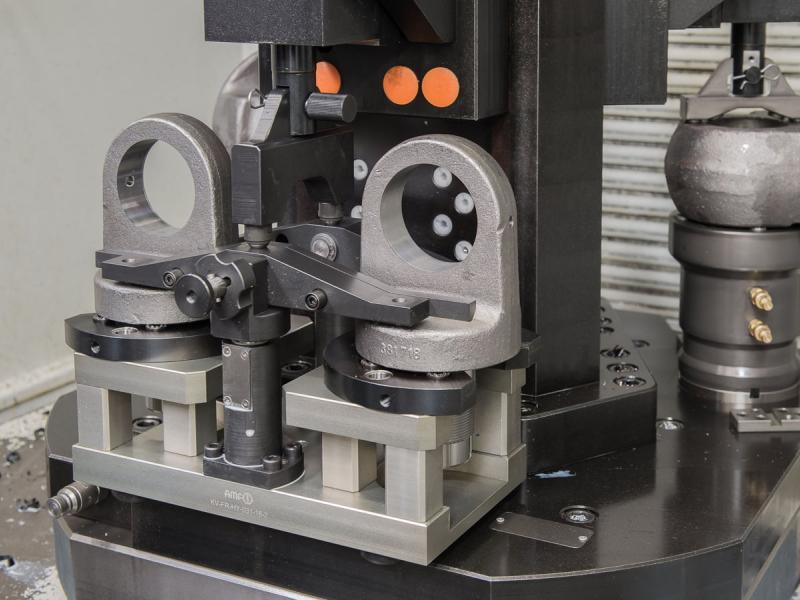
When it comes to workpiece clamping technology in increasingly complex machining processes, more is often required than just the right product or standard solutions. Sometimes, even suppliers of outstanding clamping technology encounter their limits. In addition to a comprehensive range of different solutions for workpiece clamping technology, anyone with experience, expertise and an understanding of the processes can also deliver amazing results given the right advice. In most cases, this results in customised products with fixtures for projects and processes.It becomes increasingly important as batch sizes decrease and the variety of parts increases.
"We have been receiving an increasing number of requests for comprehensive solutions that go far beyond a single clamping product," reports Chris Vogel, Head of Key Account Projects International at Andreas Maier GmbH & Co. KG (AMF). "It is above all due to constantly decreasing batch sizes and a greater variety of parts that greater flexibility is required than a single clamping element alone can provide," adds project manager Thomas Kirchner from the longestablished company based in Fellbach. Listening, understanding processes and the ability to provide sound advice are then required. The most important prerequisite is for a consulting provider to think and advise in a way that is open in terms of technology. It is quite possible for some providers to be recognised as dealing fairly with their customers. However, only a company that has access to the entire range of clamping technology can provide truly technology-neutral advice. Their portfolio should therefore include mechanical, pneumatic and hydraulic clamping elements, as well as zeropoint clamping technology, magnetic and vacuum technology and toggle clamps. And it is precisely when standard products cannot solve the problem that customised project solutions come into play. However, only a small number of providers can do this, and the industry is usually very tight-lipped.
Solution-orientated providers think in terms of technology
AMF, founded in 1890, has crystallised over the years as a provider with a completely unblinkered view and an open-minded approach to technology. The Fellbach-based company is known worldwide as a one-stop supplier of clamping technology on the machine table and is one of the market leaders. We are all the more pleased that such an authoritative provider is giving us their insights. Because, "When it comes to customised solutions with fixture construction, we stand out due to our great expertise and consulting skills," promises Vogel. "However, every project that results in a customised solution starts with an open ear – in person and without a pre-scripted questionnaire."
At the end of the day, it's always the time factor that proves to be the bottleneck. For example, how can setup times be reduced in production and machine spindle running times increased in spite of shorter call-off times while batch sizes are decreasing and the variety of parts is increasing? The topic of saving time starts much earlier – at the beginning of the fixture construction project. Kirchner explains why: "At the start of a project like this, we put together an interdisciplinary team with people from design, production and purchasing as well as a project manager. They discuss things without a hierarchy and on an equal footing, and can then take decisions within two hours, whereas other companies might require two weeks to do the same."
Speedy both internally and externally, without a hierarchy and on an equal footing
In such projects, AMF not only puts this into practice within the company, but also externally. The customer's design engineer then talks directly to AMF's design engineer. "This is precisely what our customers emphasise on a repeated basis as an extraordinary special feature that makes their work easier," assures Vogel. This agility and transparency ensure short paths and are the basic prerequisite for successful and rapid progress in projects. First, however, AMF does some work in advance. After initial discussions and having identified all aspects, the team develops one, or sometimes several, proposed solutions. Customers can then decide for themselves where the want to start and how far they want to go. So, what can customers contribute to this themselves? Vogel responds again: "This is an important part of our cooperation which is based on partnership. After all, many customers can manufacture certain elements for fixtures themselves."
Example 1: Less complexity in favour of greater precision
To make it clearer, Vogel tells us about a project for a manufacturer of high-performance pumps used in elite sports cars. Four complex cast aluminium parts are produced fully automatically and unattended. For this, AMF added a total of four new fixtures to a 5-axis machining centre with an automation system which, mounted on machine pallets, can be switched into the machine in just a few minutes and are positioned immediately thanks to zero-point clamping technology. The challenge here is fixing the blanks made of sand-cast aluminium.
In a previous concept, two components were clamped and machined per fixture. However, this meant that a lot of interfering contours restricted the machining process. "Our fixture only clamps one blank. This has reduced complexity and significantly increased process reliability." Now the BAZ, with its horizontal spindle position and swivelling table can position the workpiece to the exact tolerance for each necessary machining operation after measuring the position. The customer praised AMF as a partner who understood the processes very well, was responsive and always provided a direct contact person from the project team.
Example 2: Maximum complexity made manageable
Another example shows how maximum complexity with the greatest possible machining precision can be used to produce large castings for printing machines on flexible fixtures. To enable setup on a total of three pallets during production, AMF produced modular clamping fixtures and used their extensive standard portfolio for the hydraulic clamping elements and the zero-point clamping technology. As the machine does not have its own clamping hydraulics, AMF also contributed the hydraulic unit from its extensive range. A combination of hydraulic pull-down clamps and floating support elements fix the enormous castings in the first and second clamping to ensure perfect evenness of the parts.
Once clamped, the cast skin is removed, the contour is pre-milled, holes and threads are drilled, including those for the zero-point clamping bolts which are required for direct workpiece clamping in the next machining operation. Turned by 180°, the zero-point clamping modules hold the screwed-in pull-studs and fix the components directly, without distortion, and accessible all-round for five-sided machining. To expand the capabilities of the pallet changer and maximise flexibility, the machine pallets have AMF zero-point clamping stations, which permit fast and precise fixture change.
Ingenious fixture creates maximum flexibility for four parts
One highlight is the flexibility of the clamping devices. Two movable support plates are mounted on a base plate. Hydraulic support elements, which are easily disconnected, can easily be moved. In this way, the fixtures can accommodate two side parts that belong together as pairs, and can be machined on five sides after turning. Moreover, all four variants of the components can be clamped in the respective machining conditions. The correct positions for the respective component are colour-coded to ensure that the workers can maintain an overview despite this unimaginable complexity. That provides certainty and ensures speed during advance set-up while production is ongoing. For each component, there is both a clamping plan and a setup plan, which are available at the machine.
"Here, too, the customer was full of praise at the end. The customer could not have imagined this solution beforehand. The fact that it was able to manufacture the clamping plates itself proved to be a source of both astonishment and satisfaction. The printing press manufacturer had never before been involved in a supplier's projects in this way.
A positive conclusion when projects are implemented jointly
Machinists therefore benefit from clamping device suppliers who not only want to sell their products, but also provide genuine process support because they can listen to and understand their customers while offering expertise in fixture construction. And if the challenges are then discussed and solved directly, quickly and on an equal footing, nothing stands in the way of real added value in terms of productivity and speed.
When it comes to workpiece clamping technology in increasingly complex machining processes, more is often required than just the right product or standard solutions. Sometimes, even suppliers of outstanding clamping technology encounter their limits. In addition to a comprehensive range of different solutions for workpiece clamping technology, anyone with experience, expertise and an understanding of the processes can also deliver amazing results given the right advice. In most cases, this results in customised products with fixtures for projects and processes.It becomes increasingly important as batch sizes decrease and the variety of parts increases.
"We have been receiving an increasing number of requests for comprehensive solutions that go far beyond a single clamping product," reports Chris Vogel, Head of Key Account Projects International at Andreas Maier GmbH & Co. KG (AMF). "It is above all due to constantly decreasing batch sizes and a greater variety of parts that greater flexibility is required than a single clamping element alone can provide," adds project manager Thomas Kirchner from the longestablished company based in Fellbach. Listening, understanding processes and the ability to provide sound advice are then required. The most important prerequisite is for a consulting provider to think and advise in a way that is open in terms of technology. It is quite possible for some providers to be recognised as dealing fairly with their customers. However, only a company that has access to the entire range of clamping technology can provide truly technology-neutral advice. Their portfolio should therefore include mechanical, pneumatic and hydraulic clamping elements, as well as zeropoint clamping technology, magnetic and vacuum technology and toggle clamps. And it is precisely when standard products cannot solve the problem that customised project solutions come into play. However, only a small number of providers can do this, and the industry is usually very tight-lipped.
Solution-orientated providers think in terms of technology
AMF, founded in 1890, has crystallised over the years as a provider with a completely unblinkered view and an open-minded approach to technology. The Fellbach-based company is known worldwide as a one-stop supplier of clamping technology on the machine table and is one of the market leaders. We are all the more pleased that such an authoritative provider is giving us their insights. Because, "When it comes to customised solutions with fixture construction, we stand out due to our great expertise and consulting skills," promises Vogel. "However, every project that results in a customised solution starts with an open ear – in person and without a pre-scripted questionnaire."
At the end of the day, it's always the time factor that proves to be the bottleneck. For example, how can setup times be reduced in production and machine spindle running times increased in spite of shorter call-off times while batch sizes are decreasing and the variety of parts is increasing? The topic of saving time starts much earlier – at the beginning of the fixture construction project. Kirchner explains why: "At the start of a project like this, we put together an interdisciplinary team with people from design, production and purchasing as well as a project manager. They discuss things without a hierarchy and on an equal footing, and can then take decisions within two hours, whereas other companies might require two weeks to do the same."
Speedy both internally and externally, without a hierarchy and on an equal footing
In such projects, AMF not only puts this into practice within the company, but also externally. The customer's design engineer then talks directly to AMF's design engineer. "This is precisely what our customers emphasise on a repeated basis as an extraordinary special feature that makes their work easier," assures Vogel. This agility and transparency ensure short paths and are the basic prerequisite for successful and rapid progress in projects. First, however, AMF does some work in advance. After initial discussions and having identified all aspects, the team develops one, or sometimes several, proposed solutions. Customers can then decide for themselves where the want to start and how far they want to go. So, what can customers contribute to this themselves? Vogel responds again: "This is an important part of our cooperation which is based on partnership. After all, many customers can manufacture certain elements for fixtures themselves."
Example 1: Less complexity in favour of greater precision
To make it clearer, Vogel tells us about a project for a manufacturer of high-performance pumps used in elite sports cars. Four complex cast aluminium parts are produced fully automatically and unattended. For this, AMF added a total of four new fixtures to a 5-axis machining centre with an automation system which, mounted on machine pallets, can be switched into the machine in just a few minutes and are positioned immediately thanks to zero-point clamping technology. The challenge here is fixing the blanks made of sand-cast aluminium.
In a previous concept, two components were clamped and machined per fixture. However, this meant that a lot of interfering contours restricted the machining process. "Our fixture only clamps one blank. This has reduced complexity and significantly increased process reliability." Now the BAZ, with its horizontal spindle position and swivelling table can position the workpiece to the exact tolerance for each necessary machining operation after measuring the position. The customer praised AMF as a partner who understood the processes very well, was responsive and always provided a direct contact person from the project team.
Example 2: Maximum complexity made manageable
Another example shows how maximum complexity with the greatest possible machining precision can be used to produce large castings for printing machines on flexible fixtures. To enable setup on a total of three pallets during production, AMF produced modular clamping fixtures and used their extensive standard portfolio for the hydraulic clamping elements and the zero-point clamping technology. As the machine does not have its own clamping hydraulics, AMF also contributed the hydraulic unit from its extensive range. A combination of hydraulic pull-down clamps and floating support elements fix the enormous castings in the first and second clamping to ensure perfect evenness of the parts.
Once clamped, the cast skin is removed, the contour is pre-milled, holes and threads are drilled, including those for the zero-point clamping bolts which are required for direct workpiece clamping in the next machining operation. Turned by 180°, the zero-point clamping modules hold the screwed-in pull-studs and fix the components directly, without distortion, and accessible all-round for five-sided machining. To expand the capabilities of the pallet changer and maximise flexibility, the machine pallets have AMF zero-point clamping stations, which permit fast and precise fixture change.
Ingenious fixture creates maximum flexibility for four parts
One highlight is the flexibility of the clamping devices. Two movable support plates are mounted on a base plate. Hydraulic support elements, which are easily disconnected, can easily be moved. In this way, the fixtures can accommodate two side parts that belong together as pairs, and can be machined on five sides after turning. Moreover, all four variants of the components can be clamped in the respective machining conditions. The correct positions for the respective component are colour-coded to ensure that the workers can maintain an overview despite this unimaginable complexity. That provides certainty and ensures speed during advance set-up while production is ongoing. For each component, there is both a clamping plan and a setup plan, which are available at the machine.
"Here, too, the customer was full of praise at the end. The customer could not have imagined this solution beforehand. The fact that it was able to manufacture the clamping plates itself proved to be a source of both astonishment and satisfaction. The printing press manufacturer had never before been involved in a supplier's projects in this way.
A positive conclusion when projects are implemented jointly
Machinists therefore benefit from clamping device suppliers who not only want to sell their products, but also provide genuine process support because they can listen to and understand their customers while offering expertise in fixture construction. And if the challenges are then discussed and solved directly, quickly and on an equal footing, nothing stands in the way of real added value in terms of productivity and speed.