

Process-reliable sawing, gripping, sorting and stacking
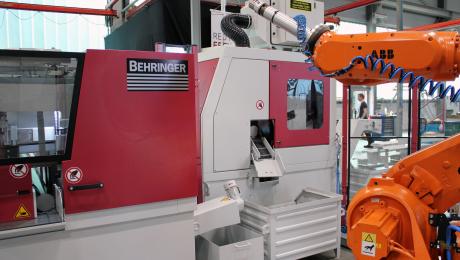
Machining operations have been made easier for users across wide-ranging sectors of industry by an innovative saw-robot combination. With an intelligent, customer-specific layout comprising high-performance sawing machines, a robot, magazines and roller conveyors, this new plant takes care of independent multiple-shift operation.
Forming the core of the plant are bandsawing machines such as the HBE321A from Behringer, or a HCS150E high-performance circular sawing machine from Behringer Eisele. These are installed upstream from the robot. The plant also offers scope for combination with a magazine to the side of the roller conveyor. This allows buffer storage of the starting lengths and ensures provision of sufficient material for unmanned night shift operation. The magazine is loaded using the hall crane, and individual bars or pipes can be transferred to the infeed roller conveyor using suitable transfer devices.
The sawing machines separate the starting lengths into defined cut sections. Depending on the application and the sector of industry, solid, hollow or profiled material is economically and precisely machined.
A feed gripper ensures smooth transportation of cut sections into the machines, and adjusts to the material being machined to ensure optimum clamping in each case. The feed gripper approaches to within a very close distance of the saw blade, allowing remnant lengths to be reduced by over 50 per cent. The gripper is mounted in linear guides and positioned by a frequency controlled drive.
On the outfeed side, a robot engages the sawn parts using a magnetic gripper. Following the transfer process, they can be distributed to different processing stations. Transportation to a cleaning, measurement or stacking station is program controlled. The robot places the parts on an automatically clocked belt which transports each good part individually into the cleaning station to be blasted by air jets and deburred using brushes. At the end of the belt, the robot engages the cleaned part. The measurement station is also located with the working area of the robot, which places the cleaned cut section into a custom-fit fixture. A measuring probe then travels over the cut sections to determine whether they comply with the specified length tolerances and degree of evenness. Following testing, the good parts are sorted by the robot in order onto a pallet which is placed ready by a roller conveyor as part of the process sequence.
The entire system is based on a safety concept which ensures optimum protection for the operator at all times. Another advantage is that the machines are generally standard solutions which can be upgraded to include peripheral devices on a customer-specific basis. This allows high-precision, ordered process sequences to be configured even in small and medium-sized companies with minimal personnel.
Machining operations have been made easier for users across wide-ranging sectors of industry by an innovative saw-robot combination. With an intelligent, customer-specific layout comprising high-performance sawing machines, a robot, magazines and roller conveyors, this new plant takes care of independent multiple-shift operation.
Forming the core of the plant are bandsawing machines such as the HBE321A from Behringer, or a HCS150E high-performance circular sawing machine from Behringer Eisele. These are installed upstream from the robot. The plant also offers scope for combination with a magazine to the side of the roller conveyor. This allows buffer storage of the starting lengths and ensures provision of sufficient material for unmanned night shift operation. The magazine is loaded using the hall crane, and individual bars or pipes can be transferred to the infeed roller conveyor using suitable transfer devices.
The sawing machines separate the starting lengths into defined cut sections. Depending on the application and the sector of industry, solid, hollow or profiled material is economically and precisely machined.
A feed gripper ensures smooth transportation of cut sections into the machines, and adjusts to the material being machined to ensure optimum clamping in each case. The feed gripper approaches to within a very close distance of the saw blade, allowing remnant lengths to be reduced by over 50 per cent. The gripper is mounted in linear guides and positioned by a frequency controlled drive.
On the outfeed side, a robot engages the sawn parts using a magnetic gripper. Following the transfer process, they can be distributed to different processing stations. Transportation to a cleaning, measurement or stacking station is program controlled. The robot places the parts on an automatically clocked belt which transports each good part individually into the cleaning station to be blasted by air jets and deburred using brushes. At the end of the belt, the robot engages the cleaned part. The measurement station is also located with the working area of the robot, which places the cleaned cut section into a custom-fit fixture. A measuring probe then travels over the cut sections to determine whether they comply with the specified length tolerances and degree of evenness. Following testing, the good parts are sorted by the robot in order onto a pallet which is placed ready by a roller conveyor as part of the process sequence.
The entire system is based on a safety concept which ensures optimum protection for the operator at all times. Another advantage is that the machines are generally standard solutions which can be upgraded to include peripheral devices on a customer-specific basis. This allows high-precision, ordered process sequences to be configured even in small and medium-sized companies with minimal personnel.