
“Automated processes are stable processes”
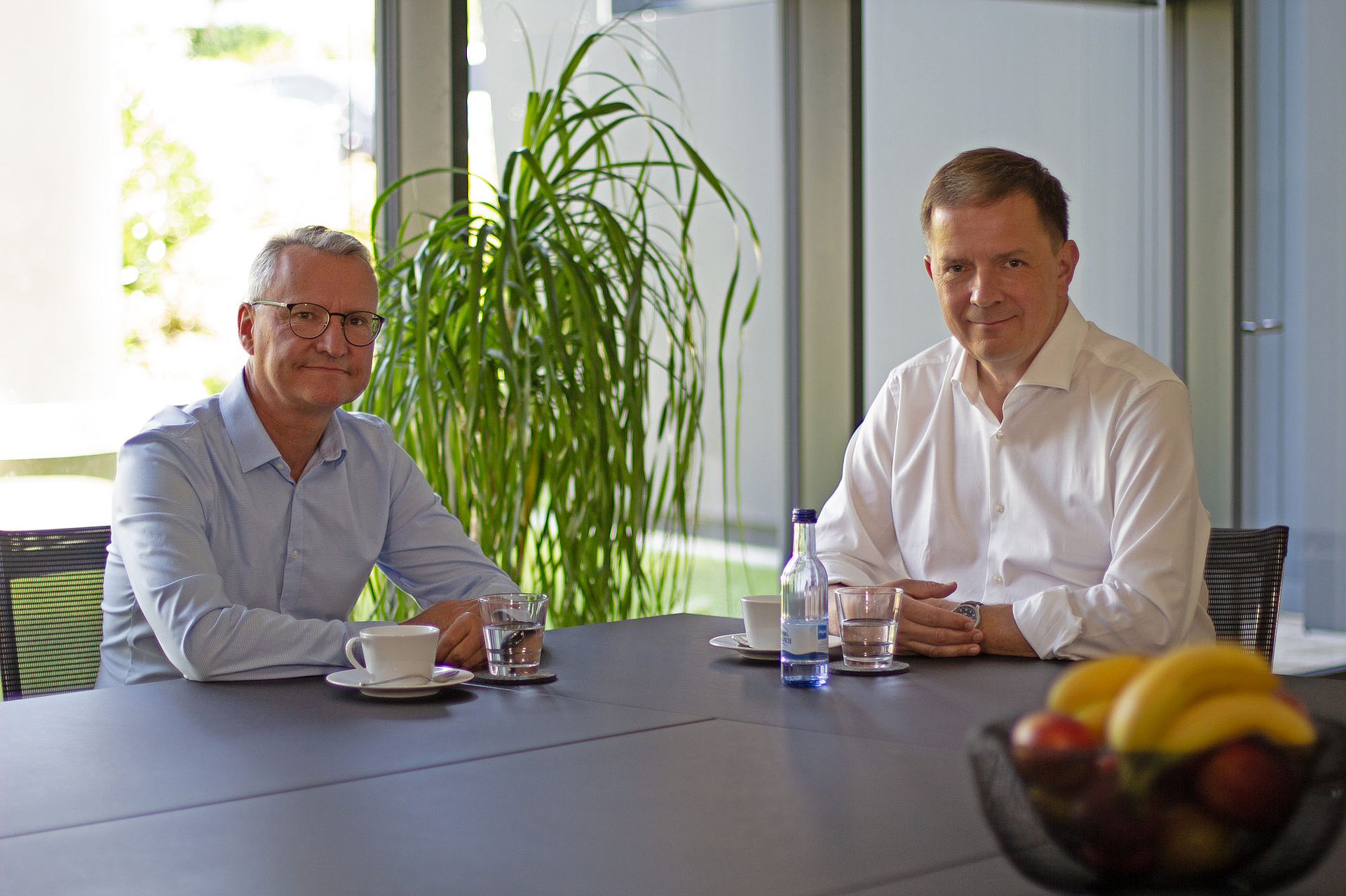
Alexander Blum, President & CEO of Blum-Novotest GmbH (AB), and Wolfgang Reiser (WR), CTO at Blum-Novotest, were available for an interview in the run-up to the big autumn trade fairs (AMB, IMTS and JIMTOF). The subject was the global economic situation and the technical innovations BLUM is using to respond to the changes.
Mr Blum, how do you see the current global situation?
We are witnessing an enormous acceleration of a development that started several years ago: The liberal, globalised world order is disintegrating. The first sign of this was the trade war that President Trump started with China and Europe. The Ukraine war and the Russian sanctions are now speeding up the development of five large blocs forming around North America, Europe, Russia, India and China. The blocs are sealing themselves off from each other more and more and at the same time trying to integrate other countries into their spheres of influence, for instance from the Global South.
Each of these blocs sees it as necessary to have certain key industries in their own hands, including aerospace and defence, energy, semiconductors and medicine. What we learned from the coronavirus pandemic was, that it’s not good if a product is only produced in one place worldwide only, reinforces this development. This has resulted in a massive restructuring of the production landscape, a change in supply flows and the structure of the blocs, which is already moving at a rapid pace.
Instead of moving low-cost production processes halfway around the world, for example to China, each of the blocs will intensify the use its own peripheral zones for these processes. In the EU, in addition to south-eastern countries such as Romania and Bulgaria, we are also increasingly seeing countries in the southern Mediterranean such as Morocco and Tunisia coming into play. We find the same movement in Asia, for example from China to Vietnam or Thailand. Each bloc will have its highly productive production clusters as well as areas in which simpler processes are automated. At the same time, bridge countries such as Mexico, Turkey and Vietnam are gaining in importance, where companies from different blocs see the chance to produce for other blocs with few trade barriers.
Alexander Blum, President & CEO of Blum-Novotest GmbH (AB), and Wolfgang Reiser (WR), CTO at Blum-Novotest, were available for an interview in the run-up to the big autumn trade fairs (AMB, IMTS and JIMTOF). The subject was the global economic situation and the technical innovations BLUM is using to respond to the changes.
Mr Blum, how do you see the current global situation?
We are witnessing an enormous acceleration of a development that started several years ago: The liberal, globalised world order is disintegrating. The first sign of this was the trade war that President Trump started with China and Europe. The Ukraine war and the Russian sanctions are now speeding up the development of five large blocs forming around North America, Europe, Russia, India and China. The blocs are sealing themselves off from each other more and more and at the same time trying to integrate other countries into their spheres of influence, for instance from the Global South.
Each of these blocs sees it as necessary to have certain key industries in their own hands, including aerospace and defence, energy, semiconductors and medicine. What we learned from the coronavirus pandemic was, that it’s not good if a product is only produced in one place worldwide only, reinforces this development. This has resulted in a massive restructuring of the production landscape, a change in supply flows and the structure of the blocs, which is already moving at a rapid pace.
Instead of moving low-cost production processes halfway around the world, for example to China, each of the blocs will intensify the use its own peripheral zones for these processes. In the EU, in addition to south-eastern countries such as Romania and Bulgaria, we are also increasingly seeing countries in the southern Mediterranean such as Morocco and Tunisia coming into play. We find the same movement in Asia, for example from China to Vietnam or Thailand. Each bloc will have its highly productive production clusters as well as areas in which simpler processes are automated. At the same time, bridge countries such as Mexico, Turkey and Vietnam are gaining in importance, where companies from different blocs see the chance to produce for other blocs with few trade barriers.