
Taking measurement technology to an elite level
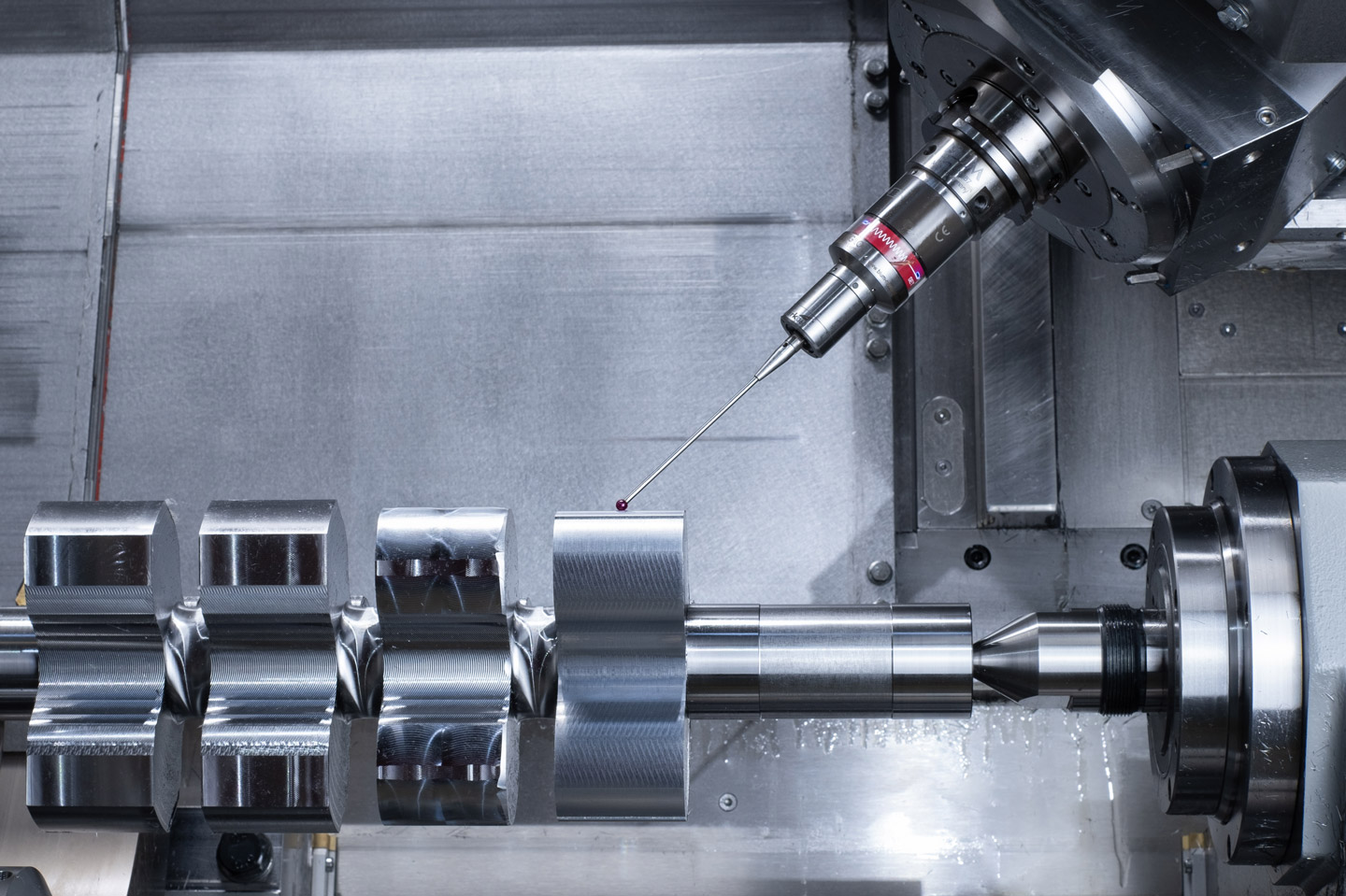
The MILLTURN machines supplied by WFL are used around the world to produce complex parts to very high tolerances. These include compressor rotors, for which the company from Linz in Austria has now developed a highly productive method for automated complete machining. A key component of this solution is the TC63-DIGILOG probe by Blum-Novotest, which is used to scan workpiece contours in a matter of seconds without the need to unclamp the workpiece from the machine.
The Tooling Solutions division within WFL Millturn Technologies specialises in cutting complicated machining sections. The goal pursued in Linz is to use intelligent tool solutions to manufacture a complex workpiece with even greater speed and precision. One example of this is the test workpiece of a Roots-type rotor. The part is the slide for a rotary-vane compressor, and is made of GG 60 grey cast iron, measuring around 400 mm long with an outer diameter of roughly 160 mm. By using special forming cutters, it turns and mills this rotor on the M40 MILLTURN machine down to gauge block standard in grinding quality. It does this automatically in a 24/7 operation, resulting in significantly shorter machining times.
Up till now, grinding was required during the rotor manufacturing process because the necessary accuracy and surface quality could not be achieved by milling. “Although the new process does not allow us to dispense with grinding in all applications, it is however sufficient that our procedure substantially reduces the amount grinding that is necessary. That is because grinding on cylindrical and profile grinding machines is always an extremely time-consuming and costly operation when it comes to compressor rotors,” explains Product Manager Manfred Baumgartner, who heads up the WFL Tooling Solutions division. “Incidentally, the finish milling for the Roots-type rotor shown, is divided across three different forming cutters and the transitions between the mills is corrected with the help of automatic measurements. Therefore, we need the combination of high-tech tools, a control component and optimum measurement technology.”
The MILLTURN machines supplied by WFL are used around the world to produce complex parts to very high tolerances. These include compressor rotors, for which the company from Linz in Austria has now developed a highly productive method for automated complete machining. A key component of this solution is the TC63-DIGILOG probe by Blum-Novotest, which is used to scan workpiece contours in a matter of seconds without the need to unclamp the workpiece from the machine.
The Tooling Solutions division within WFL Millturn Technologies specialises in cutting complicated machining sections. The goal pursued in Linz is to use intelligent tool solutions to manufacture a complex workpiece with even greater speed and precision. One example of this is the test workpiece of a Roots-type rotor. The part is the slide for a rotary-vane compressor, and is made of GG 60 grey cast iron, measuring around 400 mm long with an outer diameter of roughly 160 mm. By using special forming cutters, it turns and mills this rotor on the M40 MILLTURN machine down to gauge block standard in grinding quality. It does this automatically in a 24/7 operation, resulting in significantly shorter machining times.
Up till now, grinding was required during the rotor manufacturing process because the necessary accuracy and surface quality could not be achieved by milling. “Although the new process does not allow us to dispense with grinding in all applications, it is however sufficient that our procedure substantially reduces the amount grinding that is necessary. That is because grinding on cylindrical and profile grinding machines is always an extremely time-consuming and costly operation when it comes to compressor rotors,” explains Product Manager Manfred Baumgartner, who heads up the WFL Tooling Solutions division. “Incidentally, the finish milling for the Roots-type rotor shown, is divided across three different forming cutters and the transitions between the mills is corrected with the help of automatic measurements. Therefore, we need the combination of high-tech tools, a control component and optimum measurement technology.”