

World premiere: LASERTEC 65 DED hybrid 2. Generation: More productive thanks to hybrid complete mach
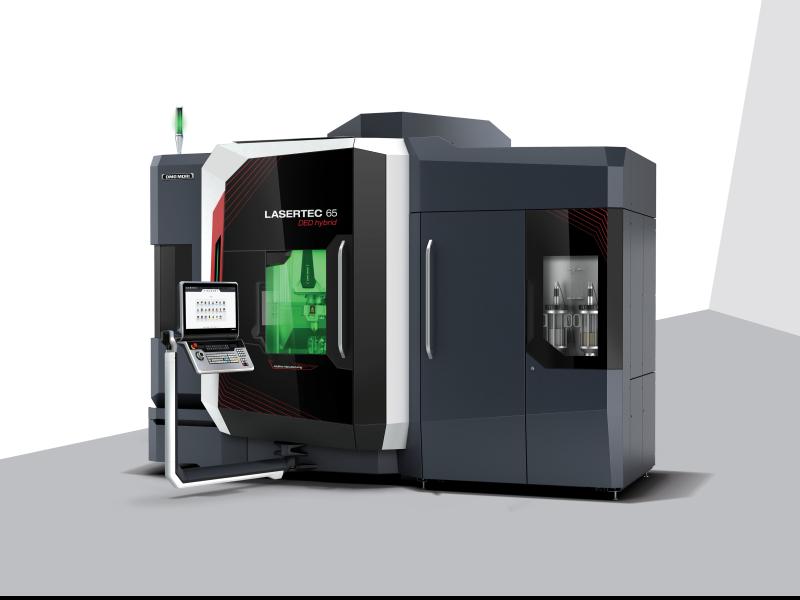
Munich. With its combination of laser deposition welding and 5-axis simultaneous milling in a single setup, the LASERTEC 65 DED hybrid has established itself as a versatile solution in additive manufacturing. It can produce highly complex geometries, repair wear parts economically, and coat workpieces with extremely hard materials. The new LASERTEC 65 DED hybrid 2. Generation carries the proven concept into the future of manufacturing. Developed consistently in line with Machining Transformation (MX), it sets new standards in process integration, productivity, and process stability. DMG MORI is thus raising additive manufacturing to an industrial level and making it suitable for series production.
Six processes in an enlarged workspace
The comprehensive 6-in-1 process on the LASERTEC 65 DED hybrid 2. Generation includes milling, turning, and grinding on the one hand, and preheating, additive manufacturing using a powder nozzle, and 3D scanning on the other. This reduces throughput times because components do not first have to be cast, transported, and reworked. The new MultiJet nozzle enables 5-axis material build-up with homogeneous powder distribution, regardless of the direction of the powder flow. DMG MORI has increased the build-up rate by 35 percent, which reduces workpiece costs by 47 percent. Compared to the previous model, workpieces up to 170 percent larger now fit into the working area – with dimensions of ø 840 x 350 mm or ø 680 x 400 mm. Calculated on the basis of the build volume, this reduces costs by over 70 percent.
More functional components thanks to multi-materials
In addition to infrared laser technology, a blue laser is also available for the LASERTEC 65 DED hybrid 2. Generation. This expands the range of materials to include highly reflective metals such as copper and allows for graded material transitions for highly functional components. For example, copper can be used to improve the cooling performance of the mold core. Material gradients between hard and soft or magnetic and non-magnetic can also be achieved for individual properties. Selective application of materials with over 60 HRC avoids additional heat treatment, gives components a longer service life, or increases the performance of existing tools, for example.
Maximum process stability and comprehensive traceability
The AM Assistant packages enable comprehensive process monitoring with cameras and sensors. Among other things, a thermal imaging camera can be used to control the temperature of the surrounding area and laser preheating. The powder mass flow is automatically calibrated and monitored by an optical sensor. Another camera monitors the thermal energy of the melt pool and contributes to the closed-loop control of the laser power. In addition, a side camera continuously checks the working distance. The AM Evaluator visualizes all relevant process data as a digital 3D model and in chronological order.
New powder management for maximum efficiency and performance
The powder is supplied in powder pots in three sizes (S: 0.5 l, M: 2.3 l, L: 5 l). DMG MORI attaches great importance to safe and efficient handling and easy cleaning. The powder is stored in argon pressure powder containers, while the finest particles in the DED module are automatically extracted when the access door to the powder conveyor is open. A pressure leak check and a level sensor can be integrated as options.
Precision and stability thanks to monoBLOCK construction
Based on the proven and rigid monoBLOCK design, the LASERTEC 65 DED hybrid 2. Generation operates with absolute precision. Positioning accuracy is 4 µm, and volumetric accuracy is 30 percent higher thanks to VCS Complete. Wide doors provide ergonomic access to the work area—even for crane loading—and are well suited for automation solutions. In addition, the CELOS X control platform on a Siemens SINUMERIK ONE and exclusive DMG MORI technology cycles make the machine easy to operate, even during programming.
Munich. With its combination of laser deposition welding and 5-axis simultaneous milling in a single setup, the LASERTEC 65 DED hybrid has established itself as a versatile solution in additive manufacturing. It can produce highly complex geometries, repair wear parts economically, and coat workpieces with extremely hard materials. The new LASERTEC 65 DED hybrid 2. Generation carries the proven concept into the future of manufacturing. Developed consistently in line with Machining Transformation (MX), it sets new standards in process integration, productivity, and process stability. DMG MORI is thus raising additive manufacturing to an industrial level and making it suitable for series production.
Six processes in an enlarged workspace
The comprehensive 6-in-1 process on the LASERTEC 65 DED hybrid 2. Generation includes milling, turning, and grinding on the one hand, and preheating, additive manufacturing using a powder nozzle, and 3D scanning on the other. This reduces throughput times because components do not first have to be cast, transported, and reworked. The new MultiJet nozzle enables 5-axis material build-up with homogeneous powder distribution, regardless of the direction of the powder flow. DMG MORI has increased the build-up rate by 35 percent, which reduces workpiece costs by 47 percent. Compared to the previous model, workpieces up to 170 percent larger now fit into the working area – with dimensions of ø 840 x 350 mm or ø 680 x 400 mm. Calculated on the basis of the build volume, this reduces costs by over 70 percent.
More functional components thanks to multi-materials
In addition to infrared laser technology, a blue laser is also available for the LASERTEC 65 DED hybrid 2. Generation. This expands the range of materials to include highly reflective metals such as copper and allows for graded material transitions for highly functional components. For example, copper can be used to improve the cooling performance of the mold core. Material gradients between hard and soft or magnetic and non-magnetic can also be achieved for individual properties. Selective application of materials with over 60 HRC avoids additional heat treatment, gives components a longer service life, or increases the performance of existing tools, for example.
Maximum process stability and comprehensive traceability
The AM Assistant packages enable comprehensive process monitoring with cameras and sensors. Among other things, a thermal imaging camera can be used to control the temperature of the surrounding area and laser preheating. The powder mass flow is automatically calibrated and monitored by an optical sensor. Another camera monitors the thermal energy of the melt pool and contributes to the closed-loop control of the laser power. In addition, a side camera continuously checks the working distance. The AM Evaluator visualizes all relevant process data as a digital 3D model and in chronological order.
New powder management for maximum efficiency and performance
The powder is supplied in powder pots in three sizes (S: 0.5 l, M: 2.3 l, L: 5 l). DMG MORI attaches great importance to safe and efficient handling and easy cleaning. The powder is stored in argon pressure powder containers, while the finest particles in the DED module are automatically extracted when the access door to the powder conveyor is open. A pressure leak check and a level sensor can be integrated as options.
Precision and stability thanks to monoBLOCK construction
Based on the proven and rigid monoBLOCK design, the LASERTEC 65 DED hybrid 2. Generation operates with absolute precision. Positioning accuracy is 4 µm, and volumetric accuracy is 30 percent higher thanks to VCS Complete. Wide doors provide ergonomic access to the work area—even for crane loading—and are well suited for automation solutions. In addition, the CELOS X control platform on a Siemens SINUMERIK ONE and exclusive DMG MORI technology cycles make the machine easy to operate, even during programming.